Southgate Statement: Middlesbrough v Chelsea 2006/07
30 years/30 games

Words: Rob Fletcher
Being a Boro fan is not easy. Seeing your side lose 4-0 in a European final was as heartbreaking as it was bizarre. Standing in that screaming hot square in Eindhoven watching Boro fans enjoy themselves is something no one will forget. Hearing Chris Rea’s ‘Steel River’ play out over an Ali Brownlee-voiced highlight reel was unforgettable.
But even before the result, there was a major distraction hanging over the club whether anyone wanted to admit it or not. The fact our manager had been recently announced as the new England manager did not help fans feelings and the team’s preparation. Steve McClaren would end his five-year tenure as Boro boss with the final against Sevilla.
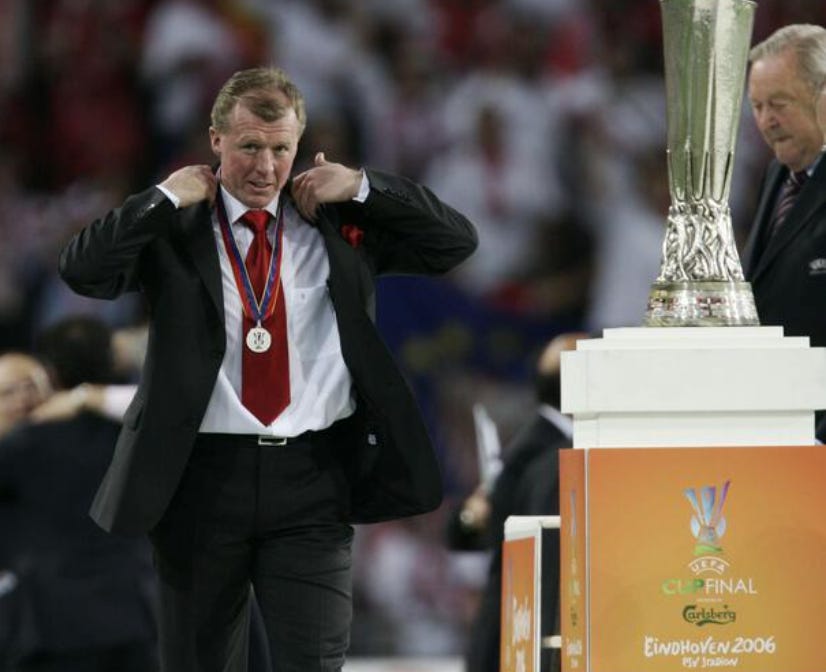
After the 4-0 defeat, probably even before that, speculation started about who would be the next Boro manager. Martin O’Neill was the clear choice but there was talk of Alan Curbishley if the ex-Leicester boss said no. Terry Venables was another Gibson choice, but he decided against a return to Teesside.
A rumour of Ottmar Hitzfeld spread as ‘The German’ on the club’s wishlist, but apparently this was Felix Magath (eventually of Fulham), who joined Wolfsburg and turned the middling German club into a Champions League team. In his Untypical Boro blog Anthony Vickers shared how Gibson did not want to become Middlesbrough-on-Rhine. Who knows how different the summer of 2006 might have been with one of those four managers in the dugout.
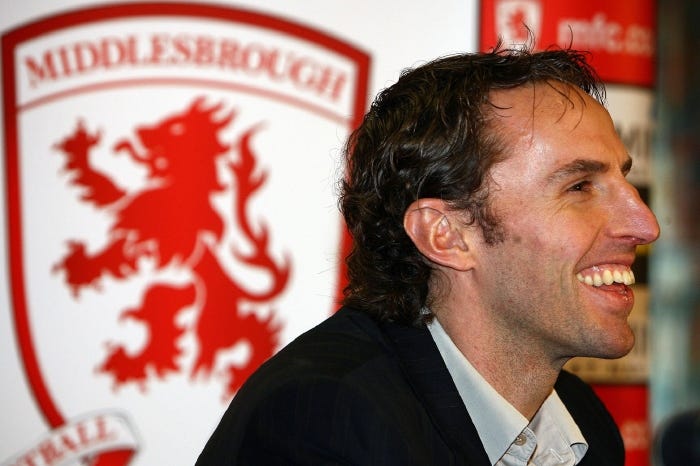
Instead we got (before he was a Sir) Gareth Southgate. Club captain and legend. A totally unqualified manager without any of the the relevant permissions to manage in the Premier League. Boro argued that he was a good pro and deserved the chance to manage because he’d been so busy being a player he could not possibly have the requisite qualifications. I’m sure we could have saved ourselves a significant amount of time if we had just appointed an actual manager. Nevermind.
While we were resolving the manager issue we started negotiations for Robert Huth, reported at the end of May according to the Independent. Something must have happened along the way as Huth didn’t actually sign until three months later!
Only two players were signed before that: Herold Goulon to bolster the reserves and Julio Arca from Sunderland to bolster the use of tiny shin pads.
Genuinely terrible recruitment coming off the back of a UEFA Cup final. To add more insult to that, the club started shedding wages too. Leaving that summer were senior players: Doriva and Jimmy Floyd Hasselbaink on free transfers and Franck Queudrue for £3m to Fulham. Carling Cup hero Joseph-Desire Job also left the club early September too.
Ambition, what ambition?
In the previous season, in December 2005, club chief exec Keith Lamb declared that if attendances did not improve then, ‘Teesside will have the football club the town’s resources can afford.’ A stark statement when the club ended up reaching and FA Cup semi-final (that we should have won against West Ham) and a European final. But, here was the club plan in action. Slash the wage bill and employ a cheaper manager.
So, with hope that another mid-table finish would be enough for fans, Boro travelled to newly-promoted Reading, who had obliterated all comers in the Championship with a record 33 game unbeaten streak and 106 points.
Boro made light work of them in the first 20 minutes, going 2-0 up thanks to Stewart Downing and Yakubu. What followed was a total collapse and a 3-2 defeat. Reading went on to have an excellent season in the Premier League, their first ever in the top flight, with an 8th place finish.
Boro welcomed the two-time, and reigning, Premier League champions Chelsea for the first home game of the season. Jose Mourinho’s juggernaut had swept aside Arsenal in 04/05 and Manchester United in 05/06 by a combined 20 points. They had just spent over £50m on new recruits Andrei Shevchenko, Salomon Kalou, John Obi Mikel and Khalid Boulahrouz (they also added Ashley Cole by the end of the window on the same day we eventually signed Huth).
Chelsea recorded an opening day victory with a straightforward 3-0 at home to Manchester City (who were still just another middle of the road Premier League team at this point). So, travelling to Boro should have provided Mourinho’s men with the chance to earn a second win. But, it wasn’t as easy as that.
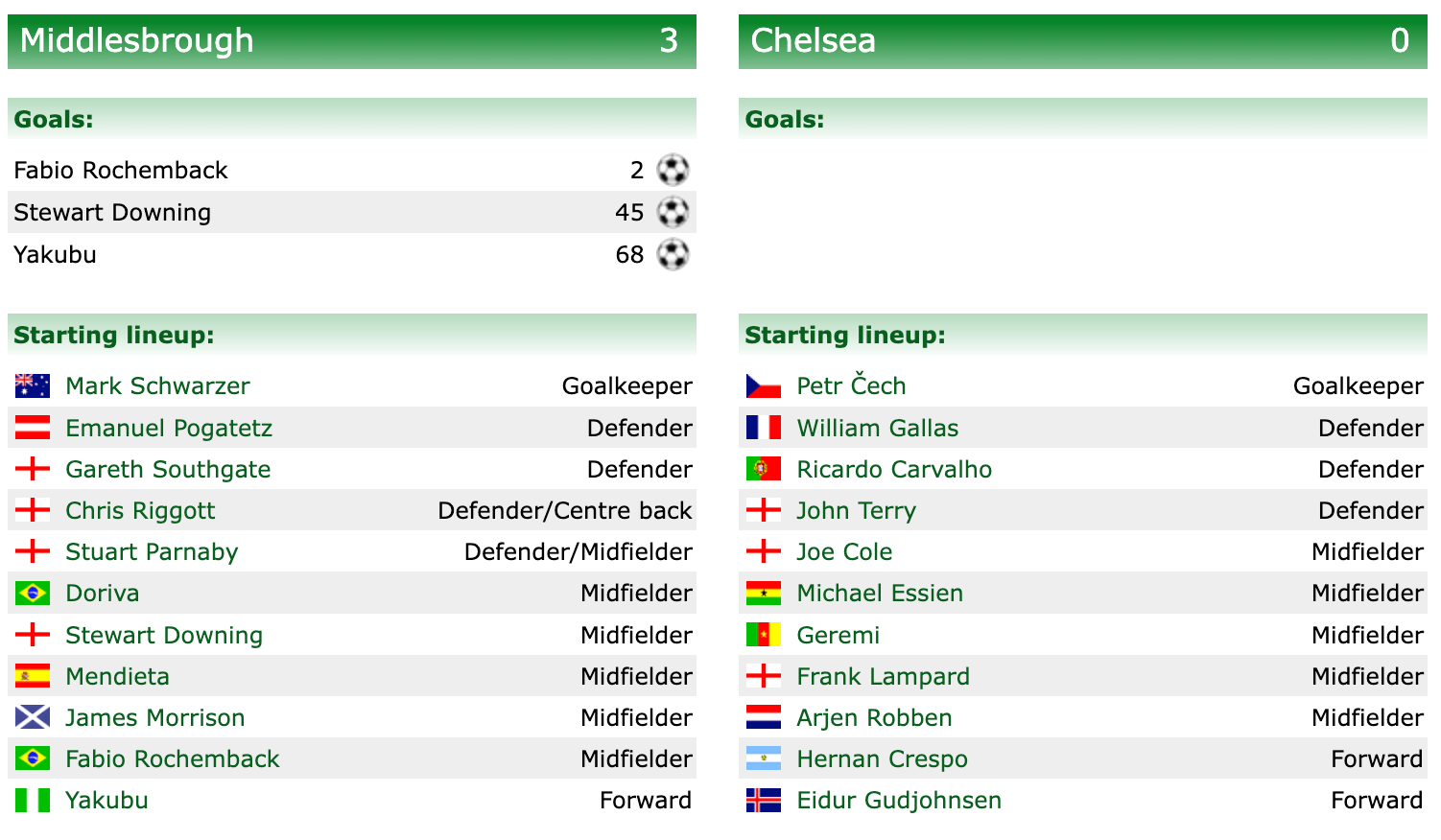
Six months earlier, Boro had already inflicted a heavy 3-0 defeat (the other four losses suffered by the champions that season were by a single goal) that was much needed by McClaren at the time. How Southgate would have loved for that type of performance from his team.
Here are the line ups for that 3-0 victory:
And the game from August 2006:
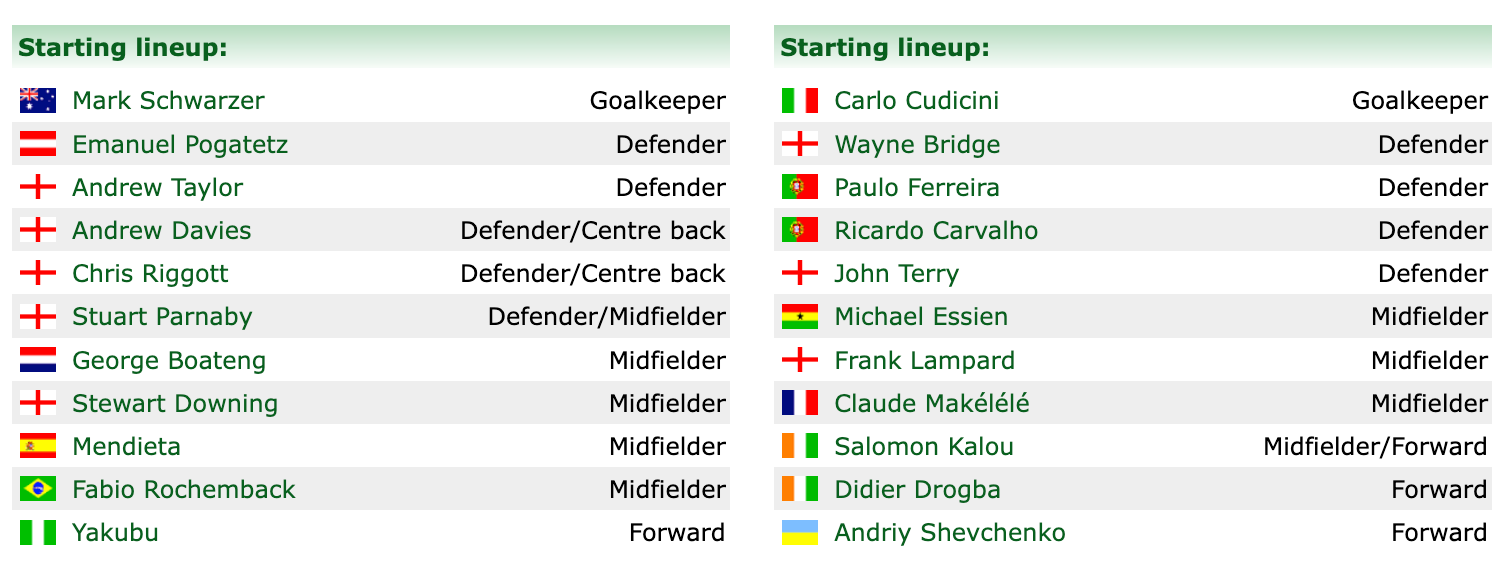
Andrew Davies started at right back, Andrew Taylor at left back with George Boateng back in the line up. Stuart Parnaby moved into midfield to create a 4-5-1 system. Mark Viduka and James Morrison had to make do with places on the bench with the hope they could make an impact later in the game.
Chelsea’s line up read like a list of the most expensive players in the league. The forward line was ridiculous too.
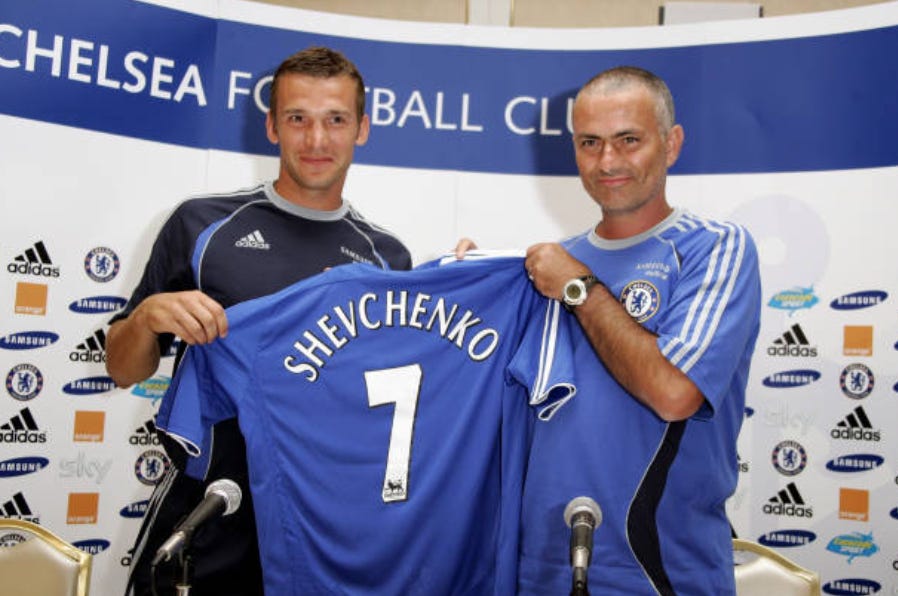
Leading the line was Andrei Shevchenko. The striker had been one of the best in the world at AC Milan scoring goals and winning trophies. He also cared little about what type of goal he scored. Like all good strikers.
After his first goal in the Community Shield loss to Liverpool, the Ukrainian got his first Premier League goal with a horrible, scuffed, deflected effort that totally wrong-footed Mark Schwarzer who ended up on his backside as the ball trickled past him. So far so predictable.
What would have been a screamer was his ridiculous free kick effort that the Boro keeper beat away from the top corner.
The home side played well in the first half and definitely did well to stay in the game and challenge the champions. At half time, veterans of the 1986 squad appeared to applause. Incredible to think the club had gone from extinction to Eindhoven in 20 years.
On the pitch and early in the second half, a rampaging Shevchenko burned past Riggott and delivered a teasing cross that Frank Lampard headed onto the bar.
Boro missed a chance of their own when Yakubu, who looked about 20 yards offside, almost found the corner flag with a header from right in front of goal.
With an hour gone, Lee Cattermole came into midfield when he replaced Davies and Parnaby reverted to right back. It wasn’t until the 72nd minute that Viduka came on for Mendieta to give Boro one final push for an equaliser.
That came in the 80th minute.
A brilliant delivery from one of the most frustrating players to ever play for Boro - Fabio Rochemback - found the big bald head of resident on-pitch hooligan Emanuel Pogatez. The Austrian powered the ball past Cudicini and found his way into the wild North Stand celebrations.
Lampard almost levelled for Chelsea with a long-range free kick that featured a typical Schwarzer parry to an onrushing attacker. Luckily, he was able to gather the rebound and hold onto it. With two minutes left, the game looked like it would end with Boro’s first point of the season. Every fan in the ground would have taken that all day long.
Mark Viduka had other ideas.
In what felt like a throwback to the Basel and Steaua games, Stewart Downing received the ball out wide and on the run. Then swung in a dangerous cross. He was so good at this during his first spell at Boro. Crossing has become an under appreciated and underused part of modern football and Downing was one of the best at it.
The deflected cross arrived in the box, bounced off Yakubu and then into the path of Viduka. The Aussie didn’t think twice. He hit it hard and low, and it deflected again, past Cudicini.
Nothing can beat that surge of the North Stand late in a game. Fans in their element from a last minute winner. 2-1 against the champions. The complete opposite feeling to the Reading defeat a few days earlier.
A massive day for Southgate and his team, but in typical Boro fashion our next home game was a 4-0 defeat to Portsmouth. We were absolutely demolished. Redknapp’s Portsmouth were in the middle of a fantastic start to the season. The win against Boro was their second in the first three games. By the middle of September they were top of the Premier League with four wins from five without conceding a goal.
Boro finished September with Chelsea as the sole victory. There were four defeats and two draws to add to the win. A poor start to Southgate’s tenure. Form did improve after Christmas with Jonathan Woodgate’s loan signing and the addition of Huth proving to be shrewd acquisitions.
At the season’s end, Boro finished a point better off than a season earlier, but two places higher. A 12th place finish, comfortable in the end, was a positive start to the Southgate era overall, but the departures of Ray Parlour, Ugo Ehiogu and Massimo Maccarone during the season then Malcolm Christie, Stuart Parnaby and Mark Viduka at the end of it, meant more rebuilding was required.
The high points of football will alwasy remain and beating the champions with a last minute winner is right up there.
Treat yourself to some extended highlights thanks to the new Premier League archive by clicking on the link.
If you didn’t know, there are now free highlights available of every game since 1992/93 so watch this one and then fill your boots with more memorable Boro moments.